95% of supplementary-roll deletions were Muslim
SABAR Institute found 2,700 of 2,826 names deleted from Nandigram's supplementary roll were Muslim, in a seat where Muslims were about 25% of the electorate.
How the BJP-led central government changed the way India's election commissioners are chosen, who was appointed under the new law, and how a nationwide re-registration of voters was timed against the election calendar. Compiled 11 October 2026 from public reporting.
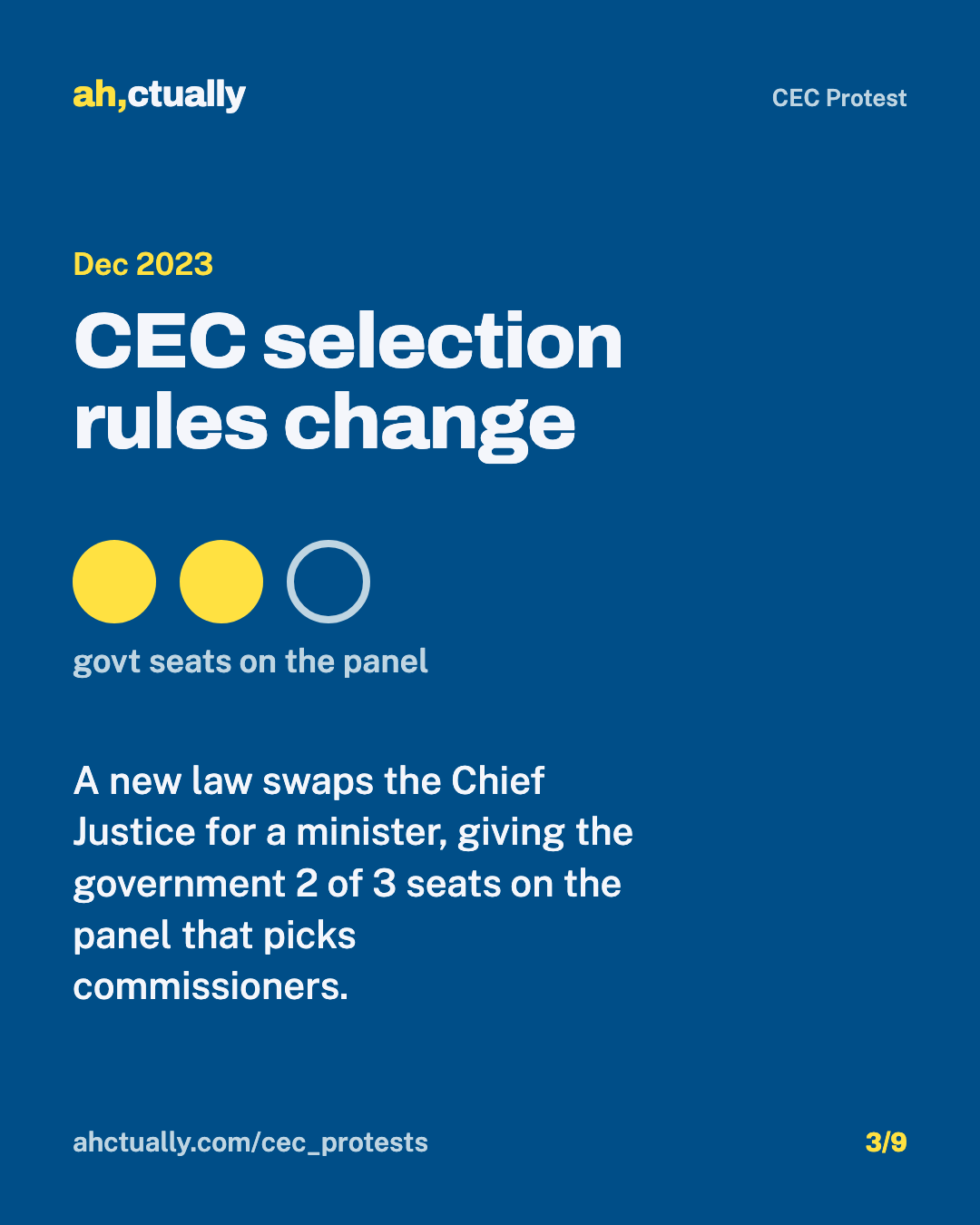
Share this report as cards ↓A new law swaps the Chief Justice for a minister, giving the government 2 of 3 seats on the panel that picks commissioners.
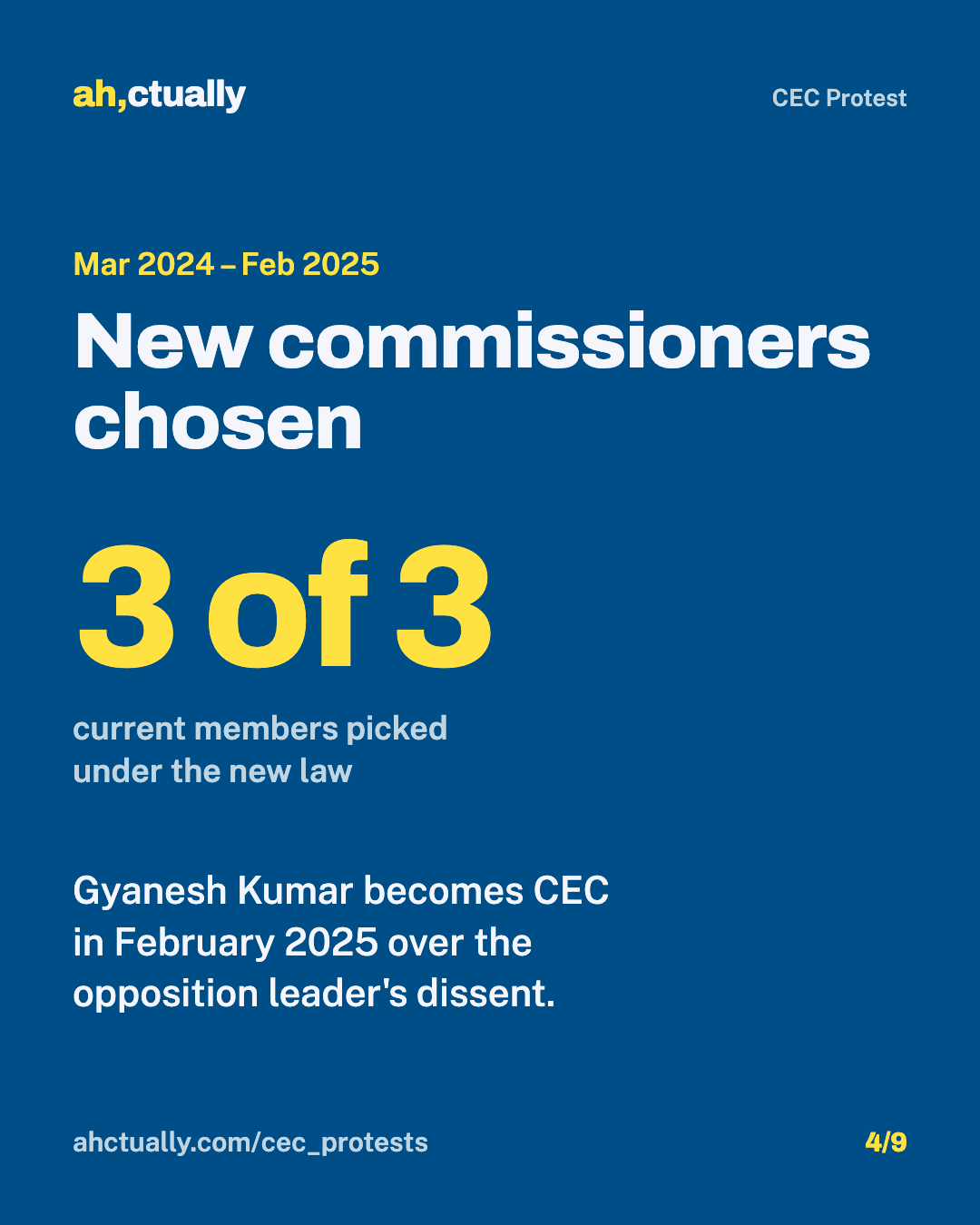
The lawGyanesh Kumar becomes CEC in February 2025 over the opposition leader's dissent.
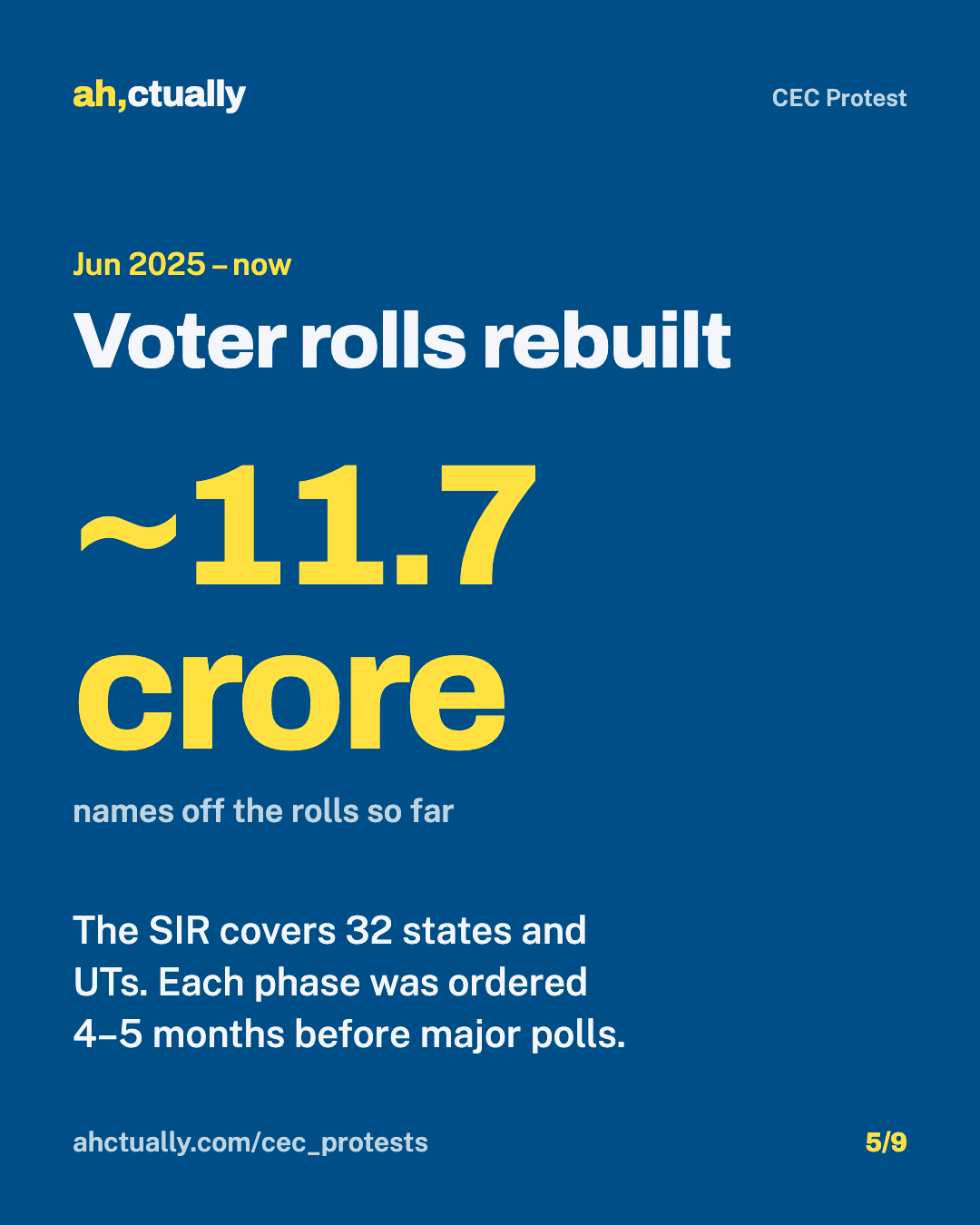
The peopleThe SIR covers 32 states and UTs. Each phase was ordered 4–5 months before major polls.
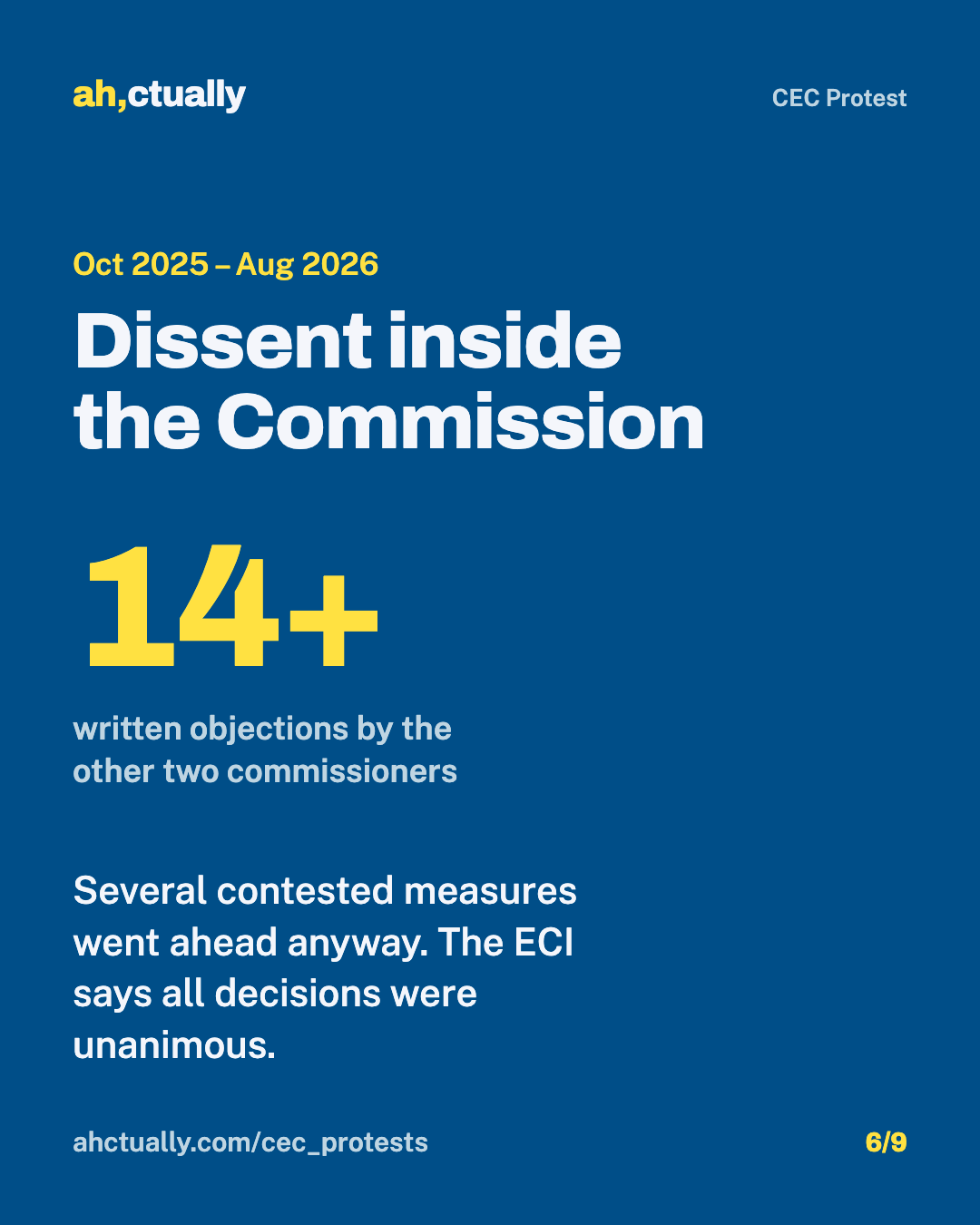
The SIRSeveral contested measures went ahead anyway. The ECI says all decisions were unanimous.
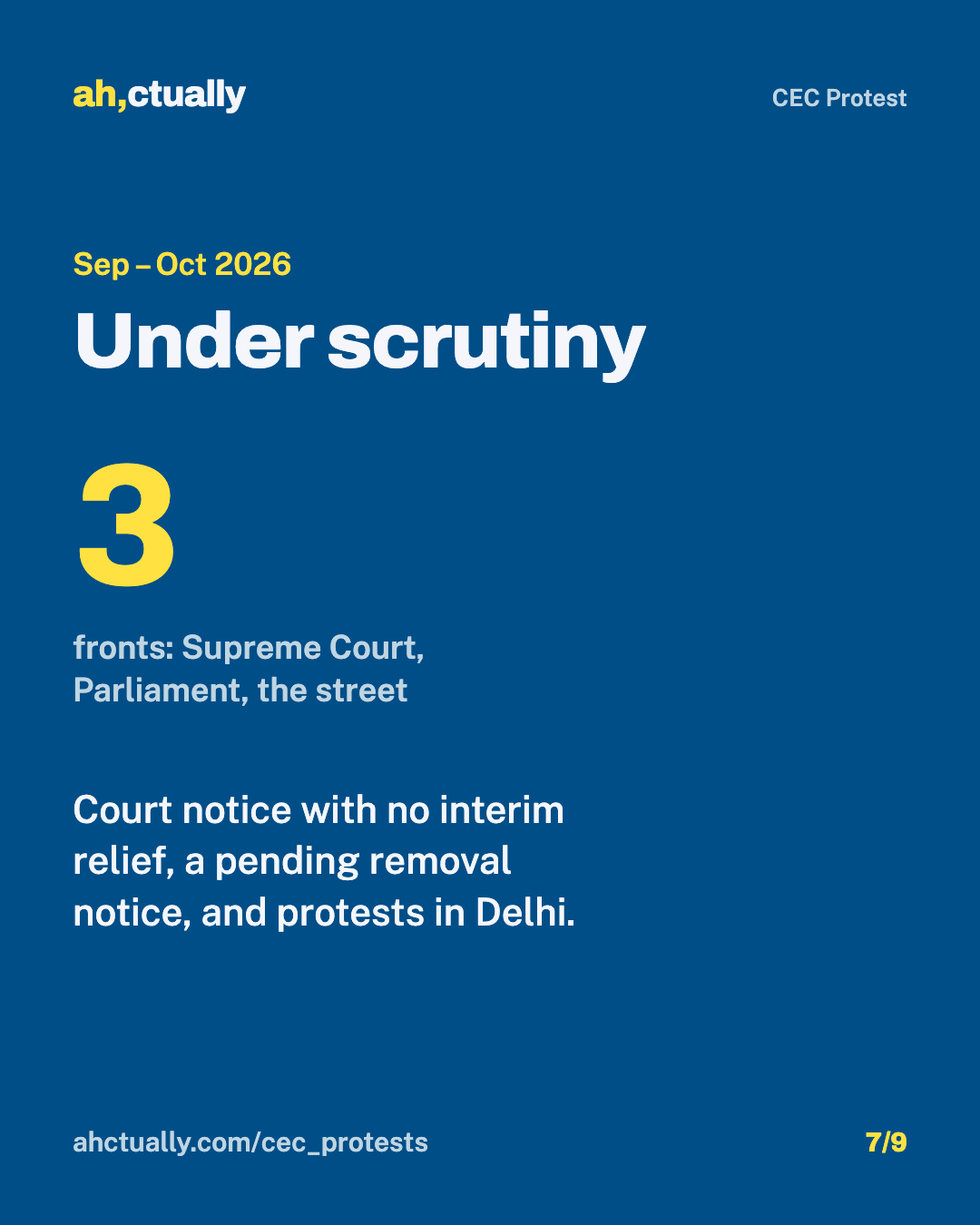
The dissentCourt notice with no interim relief, a pending removal notice, and protests in Delhi.
QuestionsBefore 2023 the government alone chose commissioners. In March 2023 the Supreme Court added the Leader of the Opposition and the Chief Justice as a check. Months later the government replaced the Chief Justice with its own minister, restoring a 2–1 government majority. The opposition opposed the bill; the government passed it anyway, by voice vote after an opposition walkout in the Rajya Sabha and with 146 opposition MPs suspended when the Lok Sabha passed it.
No law on selection. Article 324 left it to Parliament, which hadn't legislated for 73 years.
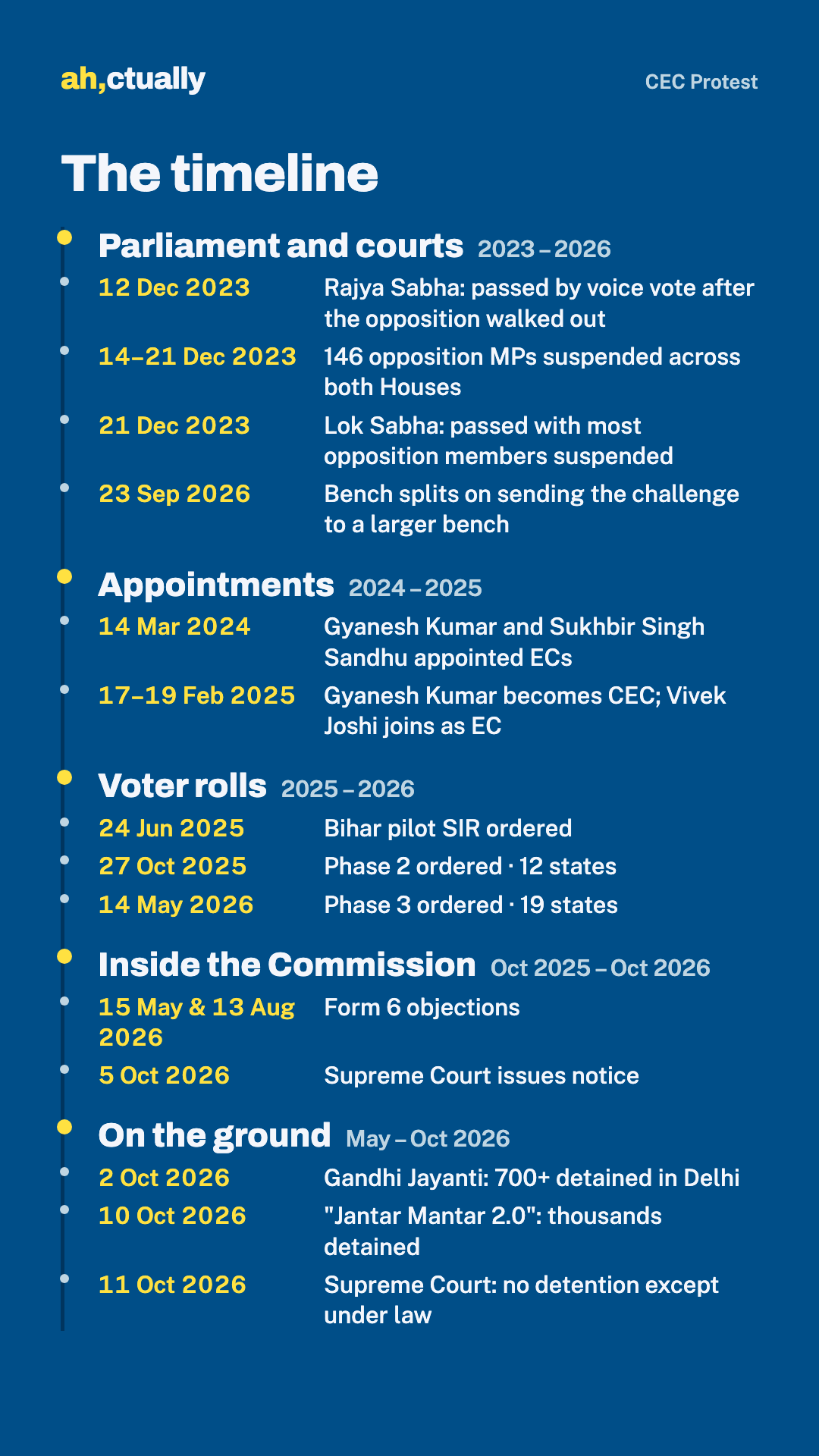
Government 1 of 3. Meant to last only until Parliament made a law.
Government 2 of 3. The Law Minister's search committee shortlists names, and the panel can pick from outside the list.
Section 7, selection committee: the Prime Minister (chair), the Leader of the Opposition in the Lok Sabha (or leader of the largest opposition party), and a Union Cabinet minister nominated by the Prime Minister. The President appoints on its recommendation.
Section 6, search committee: headed by the Law Minister with two Secretary-level officers, it shortlists five names. The selection committee may also pick someone outside that shortlist.
Enacted 28 December 2023 · replaced the Election Commission (Conditions of Service) Act, 1991.
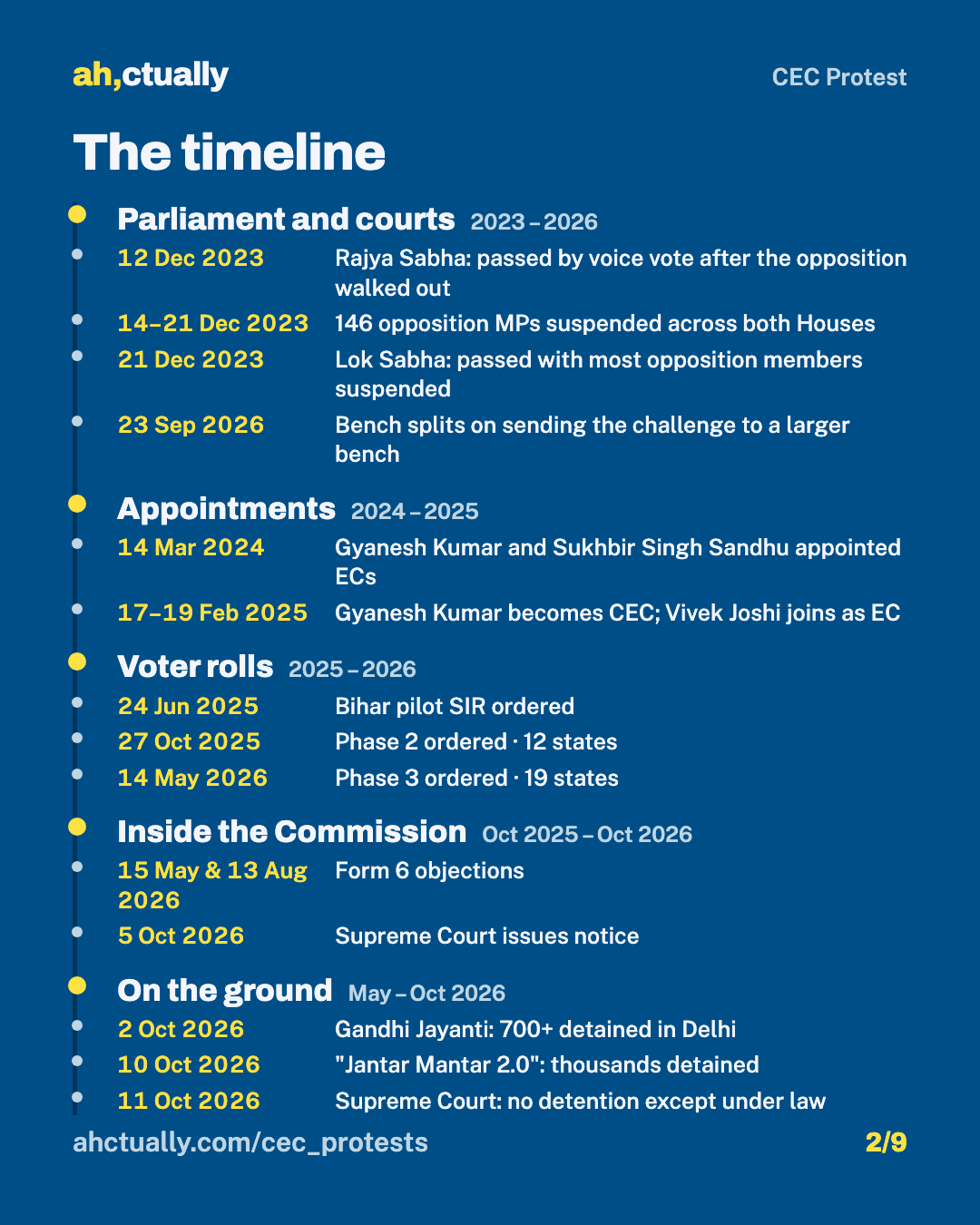
In Anoop Baranwal, the Court says the PM, LoP and CJI should pick commissioners until Parliament legislates.
The CJI is replaced by a minister of the PM's choosing, giving the government a 2–1 majority on the panel.
The opposition walked out after the minister's reply. The government did not hold a majority in the Upper House on its own.
Suspensions across both Houses during protests over the Parliament security breach.
With most opposition members suspended. Presidential assent follows on 28 Dec and it is published in the Gazette as Act No. 49 of 2023 (official text).
It refuses to halt the new law or the March 2024 appointments while challenges are heard.
Justice Datta rejects the Centre's request for a reference; Justice Sharma accepts it. The matter goes to the Chief Justice to decide on a larger bench. The Act's validity is still undecided.
Every current member of the Commission was chosen by the new panel.
The first use of the new panel. Kumar, a former Cooperation Secretary, takes charge on 15 March. The Lok Sabha schedule is announced the next day.
He was not removed. A CEC serves six years or until 65, and he reached 65. He had led since May 2022.
The panel picks Kumar on the evening of 17 Feb, ahead of a scheduled Supreme Court hearing on the Act. LoP Rahul Gandhi files a dissent note. Kumar, the first CEC chosen under the 2023 Act, takes charge on 19 Feb. His term runs to 26 January 2029.
Rolls are revised every year, but a full rebuild is rare: the last was in 2002–04. Under Kumar the Commission ran one nationwide in three phases. Each phase started a few months before a major round of state elections. Independent analyses report deletions skewed against Muslims in West Bengal and women in Bihar; the ECI denies any bias.
| Phase | Ordered | Next election milestone | Gap | Roll change |
|---|
Most "deletions" are people who did not return a form or were not found at home during the enumeration month, rather than individual findings of ineligibility. The ECI has not published additions alongside deletions for phases 2 and 3, so net figures may shrink as people re-enrol.
Independent analyses report deletions skewed against Muslims in West Bengal and against women in Bihar. The ECI denies any bias. The roll does not record religion, so community figures rest on researchers inferring religion from names. No court or independent auditor has tested these findings.
SABAR Institute found 2,700 of 2,826 names deleted from Nandigram's supplementary roll were Muslim, in a seat where Muslims were about 25% of the electorate.
Routine deletions (absent, shifted, dead, duplicate) roughly tracked population. In the "under adjudication" category about 17.7 lakh of 27 lakh deletions were Muslim. In Bhabanipur, Muslims were 22% of routine deletions but about 52% of "logical discrepancy" deletions, a category used in Bengal but not Bihar. Overall, Muslims were about 34% of all 90.6 lakh deletions against a 27% population share.
A University of Warwick economist found that in the 49 seats where adjudication deletions alone exceeded the margin, the average Muslim share was 38%, against 27% statewide. His conclusion: the SIR amplified anti-incumbency rather than creating it. In his cautious model the BJP still wins a majority.
36.6 lakh women and 29.3 lakh men were struck off in the first month, and the sex ratio on the roll fell to 892 women per 1,000 men, its lowest. Women outnumbered men among death deletions, though men are about 60% of recorded deaths in the state. Relocation after marriage may explain part of the gap, but not the death figures.
Analyses of the final roll report higher exclusion rates for Muslims, with the Muslim-majority Seemanchal region worst affected. The two lowest gender ratios were also in Muslim-majority seats.
On 1 May 2026, the UN rapporteurs on minority issues, free expression and religious freedom wrote to India. They cited Nandigram, AI-flagged "irregularities", and rhetoric conflating Indian Muslims with illegal immigrants. The government acknowledged the letter months later. A citizens' forum has also petitioned the NHRC.
The Bengal finding is the most specific: one category, used only in Bengal, accounts for most of the disparity. But the main analyses come from advocacy-linked or unnamed researchers using name-based inference, and some published figures are hard to reconcile. The ECI has not released deletions by gender, category or locality in a form that would let anyone check them directly. Publishing that data would settle much of the dispute.
The Indian Express reported on 23 September 2026 that Sandhu and Joshi recorded at least 14 objections to decisions they say were taken without them.
Orders issued in the Commission's name without the full Commission.
State EROs lose ERONet powers to add and restore names. ECINet launches on 22 Jan. The two ECs later warn of centralised control of the roll database.
Of 38 lakh SIR appeals before Bengal's tribunals, 16 lakh challenge the inclusion of voters. One petition says appeals were filed in the ECI's name without the two ECs or the state CEO knowing.
A mandatory declaration, then old-roll and parent questions, added to the online new-voter form. The ECs say the form can't change without amending the rules.
On work allocation that removed oversight of the IT division. The ECI says it concerned an officer on deputation.
Signed by all three: decisions were unanimous, agendas and minutes will now be issued, and ECINet will be reviewed for legal compliance.
Decisions must be unanimous or by majority. The Court says it has not approved a modified Form 6. No interim relief against the CEC. Replies due within a week.
A satirical online movement born in May 2026 became the loudest street voice against the CEC within days of the Express report. It issued a 48-hour ultimatum, then called people to Delhi's Jantar Mantar. Authorities responded with prohibitory orders, metro and internet shutdowns and mass detentions; the Supreme Court stepped in on 9 and 11 October.
The Cockroach Janta Party was launched online on 16 May 2026 by digital strategist Abhijeet Dipke as satire. The name answers a remark by the Chief Justice describing some unemployed youth as "cockroaches", and plays on "BJP". It is not a registered party. Its Instagram passed 20 million followers within a week. Dipke previously volunteered with AAP's social media team, which critics cite to call it political theatre.
Started a day after the Chief Justice's "cockroaches" remark. Over 10 million Instagram followers in under five days, overtaking the BJP's official handle.
The IT Ministry withholds the CJP's X account in India under Section 69A, citing national security. A new handle appears within minutes; Dipke challenges the block in the Delhi High Court.
The CJP leads protests over the NEET 2026 paper leak, including a sit-in at Jantar Mantar from 20 June. Education Minister Dharmendra Pradhan resigns in July.
A day after the Express report, the CJP demands Gyanesh Kumar resign within 48 hours, then announces protests from 2 October if he doesn't. Congress separately calls marches on state election offices.
Congress and allies hold a week of protests; the Youth Congress demonstrates in Delhi.
Police deny permission, enforce Section 163 and cut the internet around Jantar Mantar. Over 700 are detained, including AAP's Atishi and Sanjay Singh, AISA's Neha Bora and Yogendra Yadav. In Mumbai a 75-year-old protester dies of a heart attack at Shivaji Park. Dipke calls everyone to Delhi on 10 October.
Protesters return each day; about 120 are detained on 4 October. Three women journalists allege they were sexually harassed or manhandled by police; their complaints go to the Crime Branch. Police register three FIRs for breaking the prohibitory orders.
Led by Rahul Gandhi and Mallikarjun Kharge, the day after the Supreme Court's Form 6 remarks.
The CJP claims over 10,000 people were detained across India before the protest, which is unverified; Rajasthan police deny holding its spokesperson. About 11,000 extra central personnel are deployed. On 9 October the Supreme Court says there should be no blanket metro shutdown and restrictions must be proportionate.
45 metro stations shut, about 245 trains cancelled and the internet cut within 4 km of Jantar Mantar. Dipke, Saurav Das and Ashutosh Ranka are detained on landing in Delhi; Dhruv Rathee at his Gurugram home. Mamata Banerjee, Arvind Kejriwal, Yogendra Yadav and Brinda Karat are among those held; about 600 in Mumbai, including Tushar Gandhi. Police report stone-pelting that injured two officers. Counts range from over 2,000 (Home Ministry, via Reuters) to over 7,000 (media). Most are released that night, except the CJP leaders.
The UN Human Rights Office asks India to release those arbitrarily detained and respect peaceful assembly. The External Affairs Ministry calls this "unwarranted" and an unacceptable interference, saying police acted within the law.
Peaceful protesters may not be detained except by legal procedure; metro and rail must run normally; internet access stays on; barricades must be reviewed; lawyers and journalists must not be obstructed. Next hearing on 13 October. The CJP says its protest will continue; AISA's Neha Bora is detained again in Connaught Place.
This is a fast-moving situation. Detention figures vary widely by source and are often unverified. As of 11 October the CJP leaders were reported to be still in custody.
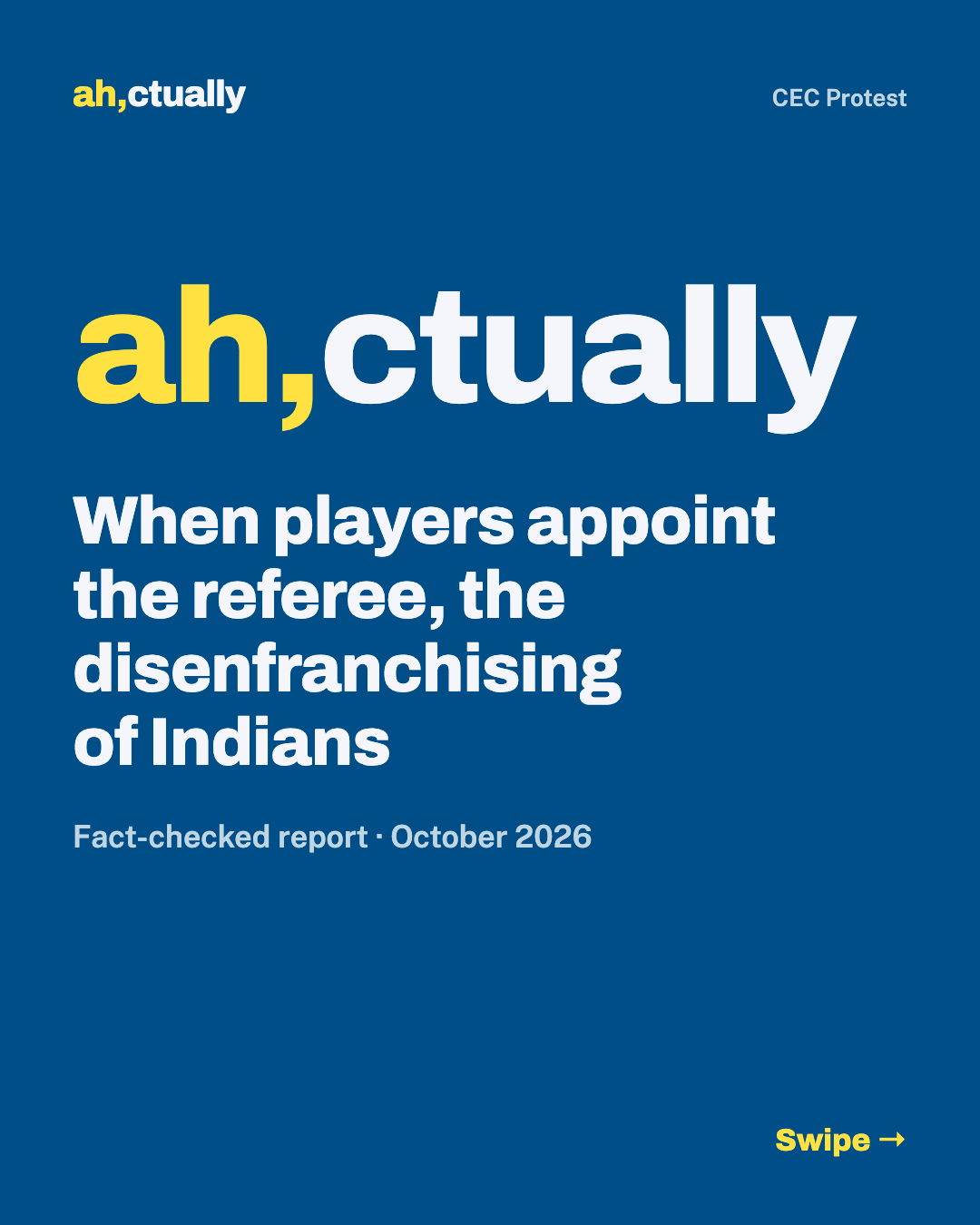
9 cards sized for Instagram and WhatsApp. Post them to your story or feed; every card carries the link back to this report.
Instagram cannot take an image from a link, so tap Share and pick Instagram in the sheet. A 9:16 story version is included.
Video explainers and news reports, grouped by topic. Videos play here; tap one to start. Titles are as published; these were found by search and have not been reviewed in full here, so check the channel before relying on one.
Everything people ask about the Commission, the SIR and the dispute, answered with the evidence. Search or browse by topic.
Gyanesh Kumar (CEC) is a 1988-batch Kerala IAS officer and former Cooperation Secretary. He has been an EC since March 2024 and CEC since 19 February 2025, with his term running to 26 January 2029.
Sukhbir Singh Sandhu has been an EC since March 2024. Vivek Joshi, a 1989-batch Haryana IAS officer and former Haryana Chief Secretary, has been an EC since February 2025.
No. A CEC serves six years or until age 65, whichever comes first. Rajiv Kumar turned 65 and left office on 18 February 2025 after leading since May 2022. Gyanesh Kumar, the senior-most EC, was elevated the next day.
In March 2023 the Supreme Court said a panel of the PM, the Leader of the Opposition and the Chief Justice should pick commissioners until Parliament passed a law. Parliament's 2023 Act replaced the Chief Justice with a Union Cabinet minister chosen by the PM. The government now holds two of the three seats.
The rule is in Section 7 of the Chief Election Commissioner and Other Election Commissioners (Appointment, Conditions of Service and Term of Office) Act, 2023 (Act No. 49 of 2023).
In the Lok Sabha the BJP had a majority on its own (about 290 of 543), and the NDA had over 330. In the Rajya Sabha the BJP was the largest party but the NDA alone was short of a majority.
In practice neither House voted against strong opposition. The Rajya Sabha passed the bill by voice vote on 12 Dec 2023 after the opposition walked out. The Lok Sabha passed it on 21 Dec, after 146 opposition MPs across both Houses had been suspended.
Yes. The Supreme Court declined to stay it in March 2024. On 23 September 2026 a two-judge bench split on whether to send the challenge to a larger bench: Justice Datta said no and Justice Sharma said yes. The Chief Justice now decides how it proceeds. The law's validity has not been ruled on.
Yes. Rahul Gandhi, the LoP and the panel's only non-government member, filed a dissent note. He argued the decision should wait for the Supreme Court hearing on the law, which was scheduled for days later.
A CEC can be removed only like a Supreme Court judge: on proven misbehaviour or incapacity, by a special majority in both Houses. The first-ever notices, signed by 130 Lok Sabha and 63 Rajya Sabha MPs, were filed on 12 March 2026. The Speaker and Chairman rejected them on 6 April. A fresh 73-MP Rajya Sabha notice filed on 24 April is pending.
A full rebuild of the voter rolls. Instead of correcting the existing list, every registered voter has to re-qualify by returning an enumeration form, and in many cases providing documents. Anyone who doesn't complete the steps is left off the new roll.
Rolls are revised every year through a lighter "summary revision". Full intensive revisions are occasional. The last were in 2002–04 (Bihar in 2003), and that roll is now the baseline voters are matched against. The ECI's power comes from Section 21 of the Representation of the People Act, 1950, which allows a special revision at any time.
What is new this time is that unmapped voters must prove eligibility with documents, and that it covers almost the whole country in about 18 months.
As proof of identity only, not citizenship. The ECI initially left it off the document list; the Supreme Court asked it to consider Aadhaar, voter ID and ration cards.
Each phase was ordered roughly four to five months before a major round of polls. Bihar's SIR was ordered about 4.4 months before Bihar voted, and phase 2 about 4.6 months before the five-state schedule. Phase 3 began days after the May 2026 results, ahead of the 2027 round. The Supreme Court questioned the timing in July 2025 but did not stop the exercise.
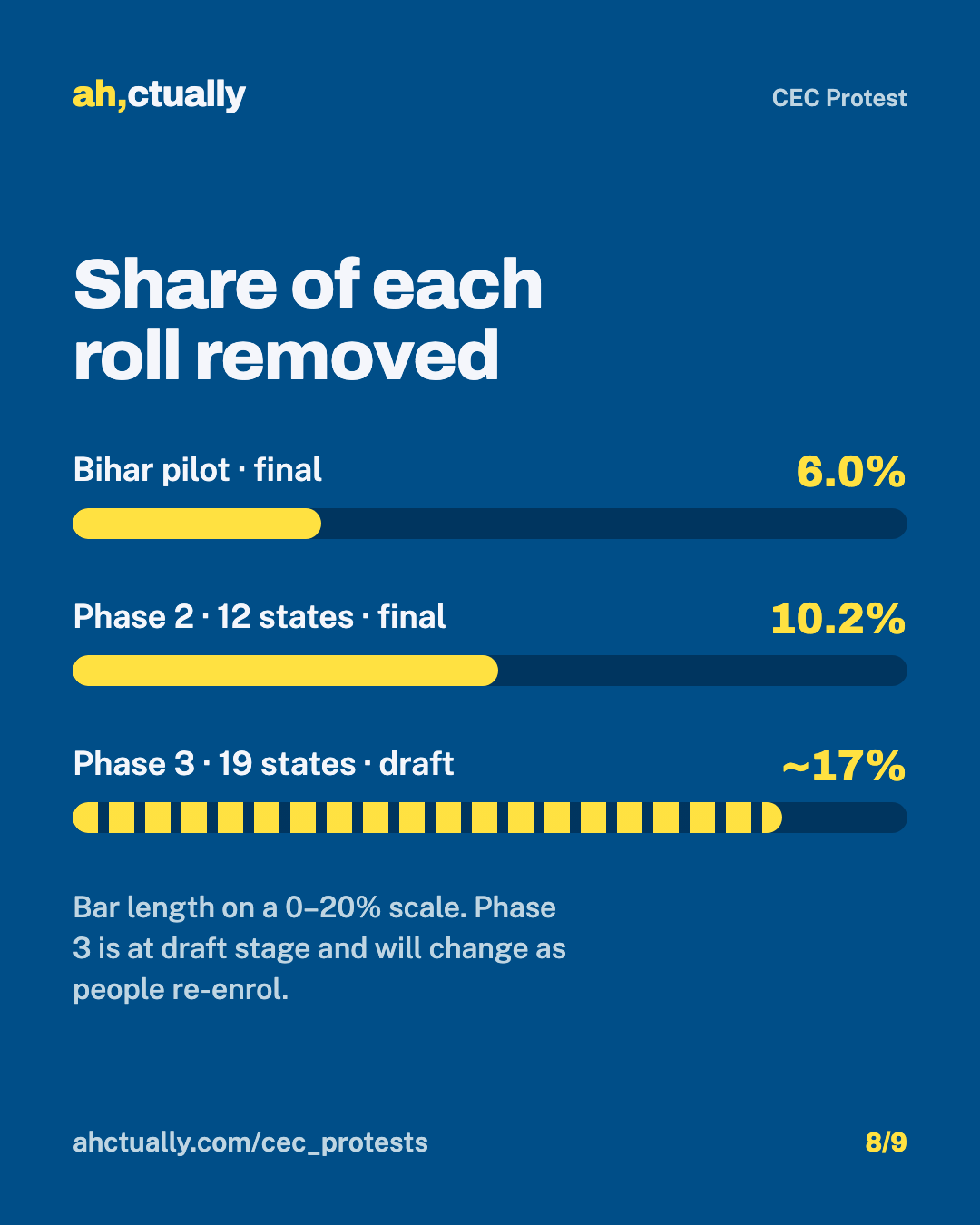
About 11.7 crore across all three phases so far, from a base of roughly 95 crore electors:
The ECI has not published additions alongside deletions for phases 2 and 3, so net figures may shrink.
In phase 2, only about 1.3 crore of the 5.18 crore drop is explained by deaths or adjudicated objections. The rest are mostly people not found, shifted, duplicated, or who didn't return the form.
Yes. Form 6 is labelled for new voters, but it is the application for anyone whose name is not on the roll: first-time voters, people who moved, and people who were deleted.
On 29 September 2026 the ECI told states where the SIR is complete (20 states and UTs) that excluded voters can re-apply through Form 6. The extra SIR declaration no longer applies to these applications; it is the plain statutory form. Officials must compare pre- and post-SIR rolls to find people deleted without sufficient grounds, and BLOs may visit to help them file. In Goa, 88 of 97 eligible voters left off the final roll have been restored or have applied.
Check your state CEO's website for the current deadlines; they vary by state and have been extended several times.
Independent analyses say yes in two places. In West Bengal, Muslims were heavily over-represented in the "logical discrepancy / under adjudication" category, with about 95% of supplementary-roll deletions in Nandigram. In Bihar, 7.6 lakh more women than men were removed. The ECI denies any bias. The figures rely on name-based inference and haven't been independently audited. See stage 3, "Patterns in who was deleted" for each claim, the ECI's response and the caveats.
Bengal set up tribunals of judicial officers to hear SIR appeals. Of 38.3 lakh appeals, 22.2 lakh were from voters who were excluded and 16.1 lakh challenged the inclusion of voters, often names judicial officers had restored. A tribunal judge said about four in ten inclusion appeals were filed by election authorities. One Supreme Court petition alleges they were filed in the ECI's name without the two ECs or the state CEO knowing.
The statutory application for inclusion in the electoral roll, prescribed by the Registration of Electors Rules, 1960. It asks you to show you are 18 or over, a citizen and ordinarily resident at the address. Changing the form itself requires the Law Ministry to amend the Rules.
In practice, yes. The online Form 6 would not submit until the declaration was completed, and one OTP covered both. For online applicants the declaration was a condition of registering, and it changed the evidence needed to get on the roll.
Whether that makes it legally invalid depends on two further questions. First, the Supreme Court (May 2026) upheld the ECI's power to require a declaration during SIR, so being mandatory is not illegal in itself. Second, the later additions came after two of the three commissioners objected; if the full Commission never approved them, they may fail on process. The Court said on 5 October 2026 that it has not approved a modified Form 6 and has asked for the records.
Whether paper applications were also refused without the declaration has not been reported. If online and paper differed, applicants faced different tests depending on how they applied.
That Form 6 itself was never changed. A separate declaration was attached through the June 2025 Bihar SIR order, approved unanimously and upheld by the Supreme Court. The declaration helps map voters and reduces paperwork, and the standard form is used outside SIR periods. It called Rahul Gandhi's claim that Form 6 was changed illegally "misleading".
That ECs Sandhu and Joshi formally recorded at least 14 objections over 10 months, four on a single day, to decisions and orders they say were issued without their knowledge or against their recommendations. The objections covered new-voter registration, deletion and restoration of names, appeals, and control of the roll database. Some were escalated to the Cabinet Secretary.
The report shows the objections were raised. It does not by itself prove misconduct.
ERONet is the system Electoral Registration Officers have long used to add, remove and restore names; the law gives that job to EROs. From November 2025 their access was reportedly restricted. ECINet, launched on 22 January 2026, consolidates election services into one central platform. Joshi warned of a "gradual centralisation" of the roll database. The question is whether central IT staff, rather than statutory officers, now control roll changes.
Dated 29 July 2026, from Sandhu and Joshi, about a change in work allocation that removed a layer of oversight of the IT division. The ECI says it concerned the working of an officer on deputation, reportedly a senior Deputy EC, and not policy or the CEC.
It has not denied the notes exist. It says differing views are a normal part of deliberation and that all final decisions, including the SIR schedules, were unanimous. On 26 September 2026 all three commissioners signed a press note announcing that agendas will be circulated in advance and minutes issued, and that ECINet will be reviewed for legal compliance.
Yes, for decisions of the Commission. The 2023 Act and the Supreme Court's T.N. Seshan ruling treat the Commission as a multi-member body: business is done unanimously where possible, otherwise by majority. On 5 October 2026 the Court reiterated that decisions must be unanimous or by majority. Petitioners argue that steps taken over two commissioners' recorded objections are therefore void.
Not all of them. Until February 2025 Rajiv Kumar was CEC, so the 2024 items were decisions of a three-member Commission that included Gyanesh Kumar and Sandhu. The Rule 93 change was notified by the Law Ministry on the ECI's recommendation. The disputed 2025–26 steps are the ones the two ECs say were taken without them.
It issued notice to the ECI and the Centre with a week to reply. It said Commission decisions must be unanimous or by majority, and presumed for now that they were. It said it has not approved a modified Form 6 and sought the records. It refused interim relief against the CEC. Rahul Gandhi said the illegality was now established; the ECI and BJP called that a misreading.
Opposition parties ran nationwide protests from 26 September to 2 October. The Youth Congress protested in Delhi. INDIA bloc MPs marched to the ECI on 6 October. On 10–11 October the youth-led Cockroach Janta Party protested in Delhi amid heavy security, with over 7,000 people reported detained.
Every answer links to public reporting, mostly national outlets and legal news sites. The Indian Express investigation itself was paywalled and is cited through other outlets that reported it. Some figures, such as phase 3 deletions, are draft-stage and will change. The history of earlier intensive revisions and the expected 2027 polling window are from general reference. Where the ECI disputes a claim, its position is given alongside.
No questions match that search.